
Learning Spanish? Here's Why New Words Don't Stick
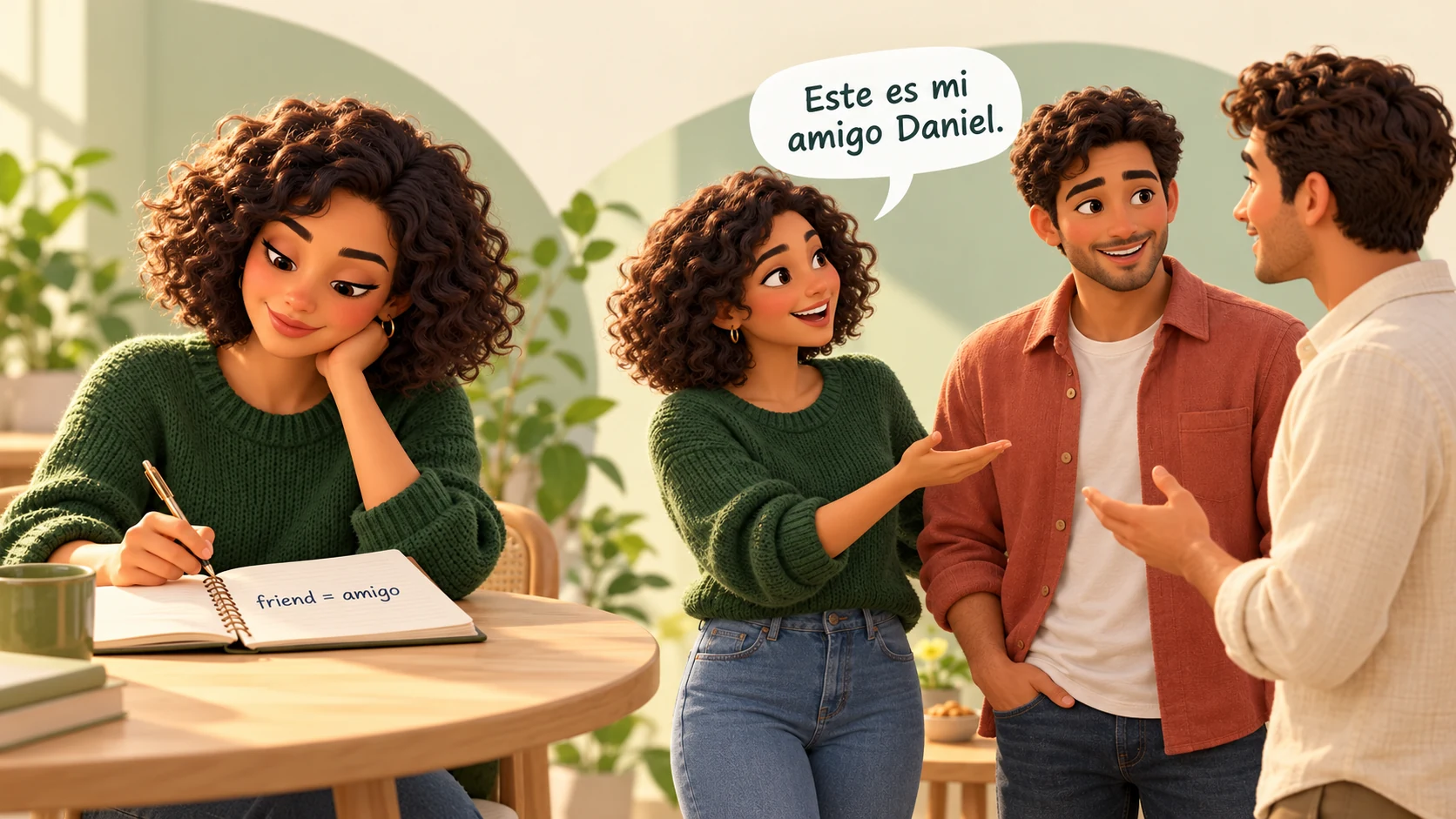
You knew the word yesterday. Today, you're looking it up again.
You repeat it a few more times, cover the translation, and get it right. For now.
Yet a scene from a film can stay with you for years: the look on someone's face, a gesture, a line you can almost hear again.
What does a word gain when it becomes part of a scene? And how can you use that when you're learning your first Spanish words?
What the vocabulary list leaves out
If your school lessons involved English in one column and Spanish in the other, you may remember the routine: read, repeat, cover, check.
| English | Spanish |
|---|---|
| water | agua |
| friend | amigo |
The translations are useful. But getting a word right while looking at a list is only one part of learning it. You also want to recognize it when you hear it and bring it to mind when you need it.
A list gives you a translation. A situation can show you what someone means, with clues from their actions, expression, and the words around it.
Compare the word agua in that table with the same word in a small scene.
Let the scene do some of the explaining
Picture a woman at a cafe. She lifts a clear glass, takes a drink, and puts it back on the table.
The sentence beside the picture says: "She takes a sip of agua."
Use the picture

She takes a sip of agua.
Show the answer
Water. Agua means water. The glass and the action help explain it.
The glass, the action, and the English sentence all point toward the same meaning. You have more to work with than a pair of words on a page.
That is what learning in context adds. You can connect agua with someone taking a drink, then meet it again when someone fills a bottle or asks for water.
In a 2023 experiment with 116 university students, learners taught German words through social scenes and contextual examples recalled word meanings better than either comparison group. The lessons included explanations and translations, too. Context and a clear explanation can work together.
You may already have picked up a word from a film
An English-language film can give you this kind of experience without feeling like a lesson.
In Pixar's Coco, a toast begins with "To our friendship!" and later includes "mi amigo." The nearby English helps explain the Spanish: mi amigo means my friend. You can check the moment in the film's screenplay, on page 87.
Here is the same idea in a simple sentence:
The sentence is easy to follow in English. The situation helps you connect the one Spanish word with the relationship between the people.
Later, you might remember amigo along with the scene. That gives you something to return to when you meet the word again.
Understanding it now and remembering it tomorrow
Working out a word's meaning is a useful beginning. Keeping it available takes more encounters and practice.
You can meet the same word in several simple situations:
She drinks agua.
He fills his bottle with agua.
Would you like some agua?
In two experiments published in 2022, learners first studied foreign words and then encountered some again in a story. Those words were remembered better one or two days later than words that did not receive the extra story encounters. Seeing a word again in an understandable setting can support learning.
There is another useful step: try finding the word yourself before checking the answer. Give this one a moment, using the cafe scene as your clue.
One word, your turn
You're thirsty. Complete the sentence with the Spanish word for water.
Show the answer
Agua. I'd like a glass of agua.
That pause is a chance to practise remembering, beyond recognizing the answer when it is already in front of you.
English can help you get started
If you are a beginner, you do not need to understand a full Spanish conversation to learn a useful word from it.
An English sentence, a familiar situation, and one Spanish word give you a manageable place to start. As words become familiar, you can build toward short Spanish phrases and sentences.
Research on bilingual memory describes how learners can use their first language to reach the meaning of new words, and how connections between words and meanings develop with experience. Kroll and colleagues discuss this in their review of bilingual language processing.
Translation is useful support. You can also practise responding to the situation itself: see the drink, remember agua, and check whether you got it right.
Flashcards can help with that practice, too. A review by Rice and Tokowicz highlights the benefits of combining repetition with recall and attention to meaning, and of spreading practice over time.
Try this with your next Spanish word
Choose one word you could use in your life. Find a short example where its meaning is clear, then give yourself a few chances to remember it.
- See
- Check
- Connect
- Recall
- Revisit
- See it in a situation. Choose a picture, a short clip, or a simple sentence you can follow. One new Spanish word is enough.
- Check what it means. Use a translation or explanation to confirm your understanding.
- Connect it with your life. Picture your own glass of water, your own friend, or somewhere you would use the word.
- Try remembering it. Hide the word and use the picture or English sentence as a clue. Check your answer afterward.
- Come back to it. Try again later and on another day. Adjust how often you revisit it according to what you remember.
The next time you study agua, give it a glass, a thirsty person, and a reason to be said. Then see whether you can bring it to mind when the word is hidden.
Sources and further reading
- Rice, C. A., and Tokowicz, N. (2020). A Review of Laboratory Studies of Adult Second Language Vocabulary Training. Studies in Second Language Acquisition, 42(2), 439-470. Published online in 2019.
- Zhang, Z., Li, H., and Zhou, J. (2023). Teaching with social context in instructional video facilitates second language vocabulary learning. Heliyon, 9(3), e14540.
- Kroll, J. F., van Hell, J. G., Tokowicz, N., and Green, D. W. (2010). The Revised Hierarchical Model: A critical review and assessment. Bilingualism: Language and Cognition, 13(3), 373-381.
- Van den Broek, G. S. E., Wesseling, E., Huijssen, L., Lettink, M., and van Gog, T. (2022). Vocabulary Learning During Reading: Benefits of Contextual Inferences Versus Retrieval Opportunities. Cognitive Science, 46(4), e13135.
- Molina, A., and Aldrich, M. (2017). Coco screenplay. Disney/Pixar, p. 87. Publicly hosted screenplay copy; used to verify the film example.