Learning Spanish? Don't Let Grammar Keep You Quiet
You know what you want to say. Then you start checking it.
The verb. The word order. The ending. What if you get it wrong and remember it that way?
A moment later, you've decided to say nothing.
It's easy to treat beginner mistakes as something you must prevent at all costs. But you can learn a correct form after using an incorrect one. You don't have to get every sentence right before you start speaking Spanish.
Will a mistake stay with you forever?
Getting something wrong a few times does not mean you have permanently learned it that way. You can notice the difference, hear a useful explanation, and practise the correct version.
Some recurring errors take more work to change. Simply repeating a mistake without checking it can keep a habit going. The useful response is to give yourself a clear model and opportunities to use it.
- Try it
- Check it
- Adjust it
- Use it again
What if I make the same mistake again?
Pick that one pattern to revisit. Look at a correct example, try a fresh example of your own, and return to it in another practice session. A repeated mistake gives you something specific to work on.
In an experiment with adult English learners, researchers gave feedback on grammar errors during speaking tasks. Clear explanations helped learners improve their use of a past-tense pattern on tests two weeks later. These learners already had some knowledge of the rule; correction helped them use it more accurately.
The broader picture is encouraging, too. A review of 15 classroom studies found that oral correction benefited language learning, with improvements still evident on later tests.
Children give us a familiar reminder that language develops through imperfect attempts. A child might say "comed" instead of "came" while working out English past tense. In research on 83 children's speech, errors of this kind were less frequent for verbs whose correct forms parents used more often. Correct examples matter as learning continues.
Start with words that mean something to you
Before a grammar rule can help you express an idea, you need some words to work with.
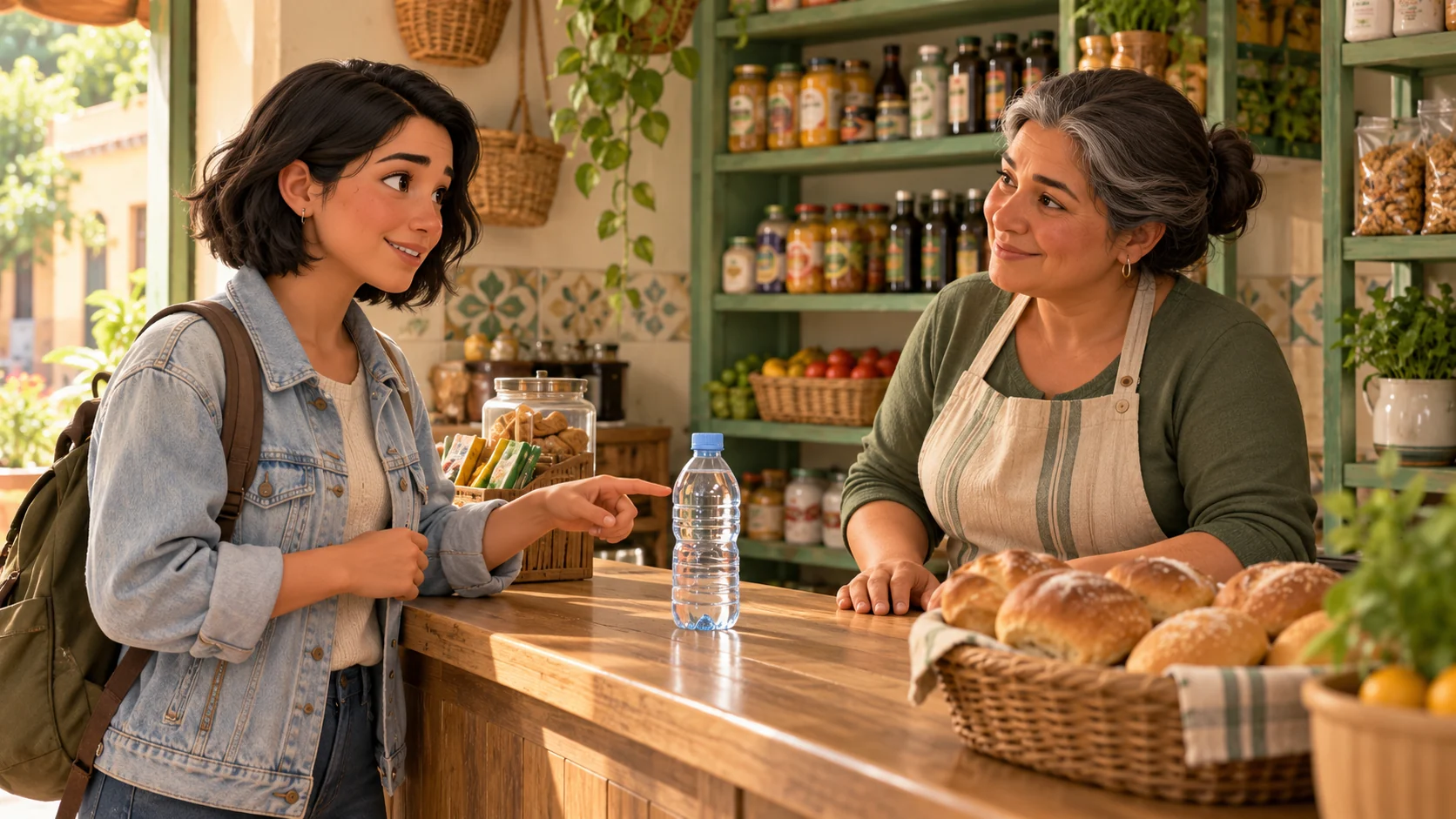
That can begin with something as ordinary as a glass of water. See someone take a drink, understand what they are doing, and connect the Spanish word agua with water.

- aguawater
- panbread
The word has a meaning you can picture. Later, when you want to talk about a drink, you have something to reach for.
We explore this in Learning Spanish? Here's Why New Words Don't Stick: a scene can help explain a word, and meeting it again gives you more chances to remember it. Translation and recall practice can help alongside that context.
You can start adding small pieces of grammar as you build that vocabulary. You don't need to finish learning words before you try a sentence.
Make the grammar lesson small enough to use
Suppose you know two words: agua means water, and pan means bread.
Here is one useful addition: quiero means I want.
That gives you a small pattern you can use with either word:
Quiero agua.
I want water.
Quiero pan.
I want bread.
What did we add?
You've just learned that quiero means 'I want'.
Show the answer
Quiero means I want. Quiero agua. I want water. Quiero pan. I want bread.
For now, keep the same speaker and the same simple situation. Choose something you want and practise saying it. A short explanation gives you a starting point; using the pattern gives it a job to do.
A full table of verb forms can wait until you have a reason to explore more of it. You can learn one useful part and give yourself room to get comfortable with it.
Give the idea more than one turn
It's tempting to finish a grammar explanation, get an exercise right, and move straight to the next topic.
Try leaving more room for the part where you use it.

Use quiero with a drink. Use it with a food. Look at the English meaning, cover the Spanish, and see whether you can bring the phrase back. Check it, then try again another day.
A research review of spaced practice in language learning found benefits from spreading practice out. Give a useful pattern several returns, rather than treating one successful exercise as the end of the lesson.
- First: Understand it
Quiero agua.
I want water. - Next: Use it again
Quiero pan.
I want bread. - Later: Bring it back
Think of something you want. Try the pattern, then check it.
Return to earlier patterns as you add new ones.
Move forward when you can understand the pattern and use it in a few familiar situations with less help. You may still hesitate or make an occasional mistake. You can add the next small idea while continuing to revisit the first.
The aim is to make the next lesson manageable. Familiar words and patterns give you something steady to build on.
Let correction give you your next example
If someone corrects you, ask for a version you can actually use: "How would you say that?"
Listen to the corrected phrase. Check what it means. Try it yourself, then use it in another simple example. If you keep missing the same part, ask for a brief explanation of that part.
You can also ask a practice partner to let you finish your thought and help you with one useful correction afterwards. That gives you room to communicate and something specific to practise next.
Here is a small chance to use the pattern from this article.
One small phrase, your turn
Quiero means I want. Agua means water. Complete the Spanish phrase for I want water.
Show the answer
Quiero agua. I want water.
Add the next piece when it has somewhere to fit
After using quiero for what you want, a later lesson might show you how to talk about what someone else wants. Keep the things you talk about familiar while introducing that one change.
What could the next small lesson look like?
Quieres means you want. The verb form changes when speaking about you. You can keep the word for water familiar:
Quiero agua.
I want water.
¿Quieres agua?
Do you want water?
As each part becomes more familiar, you have less to work out from scratch. Keep using earlier patterns as new ones arrive. If an old mistake comes back, give that pattern another turn.
This is the approach behind Bambolingua's short grammar lessons: learn words in context, introduce a grammar idea with familiar words, and practise using it in sentences.
Next time you have something to say, try expressing it with the Spanish you have. Ask for help with the part you need. You can start a conversation today and keep learning how to say more.
Sources and further reading
- Ellis, R., Loewen, S., and Erlam, R. (2006). Implicit and explicit corrective feedback and the acquisition of L2 grammar. Studies in Second Language Acquisition, 28(2), 339-368. An experiment with 34 adult English learners examining feedback on a partly learned past-tense form.
- Lyster, R., and Saito, K. (2010). Oral feedback in classroom SLA: A meta-analysis. Studies in Second Language Acquisition, 32(2), 265-302. A synthesis of 15 classroom studies involving 827 learners.
- Marcus, G. F., Pinker, S., Ullman, M., Hollander, M., Rosen, T. J., and Xu, F. (1992). Overregularization in language acquisition. Monographs of the Society for Research in Child Development, 57(4), 1-182. An analysis of children's past-tense errors and the patterns associated with them.
- Kim, S. K., and Webb, S. (2022). The effects of spaced practice on second language learning: A meta-analysis. Language Learning, 72(1), 269-319. A synthesis of 48 experiments across several language-learning targets; it does not prescribe a fixed number of days for each grammar topic.